
911 Calls, Bodycam, and DNA Evidence From the Gun
Day 2 of Tracey Grist’s trial moved from the family’s planning conversations into the immediate aftermath of Matthew Restelli’s killing. Jurors heard from neighbors who reported the gunfire, watched surveillance and police bodycam footage, and got autopsy testimony detailing the seven gunshot wounds Restelli suffered. They also heard DNA testimony tied to the pistol and magazine prosecutors say Kevin Ellis used in the shooting.
Neighbor testimony put the shooting on a timeline
Kaitlyn Laney, who lived near Tracey Grist, testified that she called 911 on the evening of July 12, 2024, after hearing what she believed were gunshots. She described hearing six to eight loud bangs in succession, with what she thought may have been a pause before the final shot.
Laney also told jurors she texted Grist before calling 911. In that exchange, Grist acknowledged that Kevin Ellis had shot Matthew Restelli. That message gave jurors one of the clearest early statements tying Ellis to the killing in real time.
Another neighbor, Brent Laney, also testified that he heard gunshots that night. Dave Kreuger, who lived across the street from Grist, testified as jurors were shown footage from his home surveillance system.

Kathryn Restelli returned to the stand
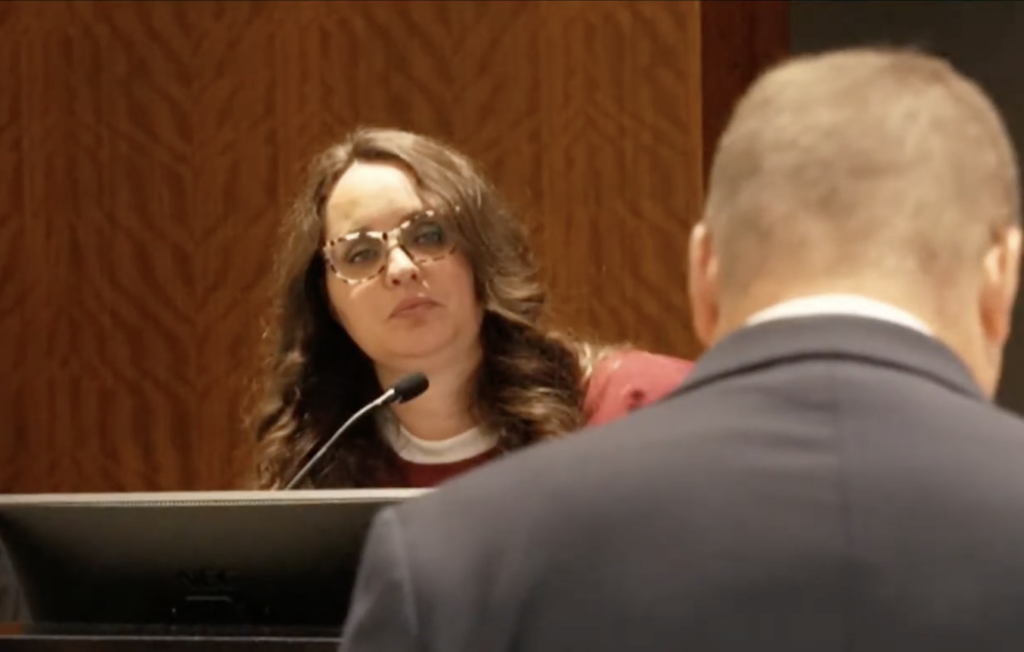
Kathryn Restelli took the stand again and spent part of the day addressing her plea agreement and inconsistencies in earlier testimony from Kevin Ellis’s trial. She said she had lied before in an effort to protect Ellis and Grist.
That testimony was important because Kathryn is one of the prosecution’s central witnesses, and the defense is likely to focus heavily on her credibility. By raising those prior inconsistencies directly, the state continued building its case with a witness jurors already know has admitted both participation in the plot and past dishonesty.
Bodycam footage showed what officers found inside
Officer David Guerra of the American Fork Police Department testified that he responded to Grist’s home the night Matthew Restelli was killed. Jurors watched bodycam footage from the scene.
Guerra said Kevin Ellis answered the door when he arrived. Once inside, he saw Restelli lying face down with a pocket knife near the body. Guerra checked for signs of life, found no pulse, and saw that Restelli was not breathing. He performed CPR for less than two minutes until paramedics arrived.
That testimony gave jurors the first detailed law enforcement account of how the scene looked when officers entered the house, including the placement of the knife near Restelli’s body, an issue that goes directly to the prosecution’s claim that the self-defense narrative was staged.

The medical examiner described seven gunshot wounds
Dr. Amanda Ho, an assistant medical examiner, testified that she performed Matthew Restelli’s autopsy on July 15, 2024. She told jurors Restelli suffered a total of seven gunshot wounds.
According to Ho, three of those bullets entered and exited the body, while four entered but did not exit. She testified that the shooting caused damage to both lungs, the heart, diaphragm, liver, stomach, spleen, kidney, and ribs.
Her testimony gave the jury a clinical account of the violence of the shooting and reinforced the prosecution’s position that Restelli was hit repeatedly after entering the home.

DNA analyst linked Kevin Ellis to the gun
Jurors also heard from a DNA analyst, and a results screen shown in court added another piece to the physical evidence.
The visible portion of the report shown to jurors concerned cuttings of swabs from a “SIG SAUER P365” 9mm pistol and empty magazine. That page stated there was “very strong support for inclusion” of Kevin Ellis in the mixed DNA profile. It also listed “moderate support for exclusion” for Kathryn Restelli, “limited support for exclusion” for Tracey Grist, and “exclusion” for Matthew Restelli.
The screenshot also appeared to show discussion of DNA results from the pocket knife, including support for mixtures involving Matthew Restelli with Kevin Ellis or Matthew Restelli with Tracey Grist, though the visible text did not show the full section. The portion that was clearly readable on the gun-and-magazine page pointed most directly to Ellis.
Why Day 2 matters
The second day gave jurors a much more concrete picture of what happened after the shots were fired and what physical evidence prosecutors say supports their theory. The neighbor testimony helped establish timing. The bodycam footage showed the condition of the scene when police arrived. The autopsy testimony laid out the extent of the gunshot wounds. And the DNA evidence, at least from the portion shown in court, added support for Ellis’s connection to the firearm.
For the defense, Kevin Ellis’s role is not the disputed point. The harder question remains whether prosecutors can use the surrounding evidence and witness testimony to prove that Tracey Grist helped plan the killing and the attempted self-defense narrative.
What comes next
By the end of Day 2, jurors had heard evidence about the shots, the scene inside the house, and the gun itself. The case is now moving deeper into the forensic and credibility issues that could shape how jurors view Grist’s role.
The state still has to connect those pieces back to planning and intent. The defense, meanwhile, will likely keep pressing the idea that Ellis was the shooter, Kathryn is compromised, and the prosecution is trying to stretch one man’s actions into a wider conspiracy.